Patios & Paving · Concept

Heritage Patio — Kilkenny Blue Limestone, Random Pattern

Formal Irish garden patio in sawn Kilkenny Blue Limestone with lime mortar joints. Reads period even when laid new. €3,600–€6,800 installed for 30 m².

Indicative budget: €3,600–€6,800 (EUR for 30 m² supplied and installed in Ireland, 2026) · 12 May 2026 · By found.rocks
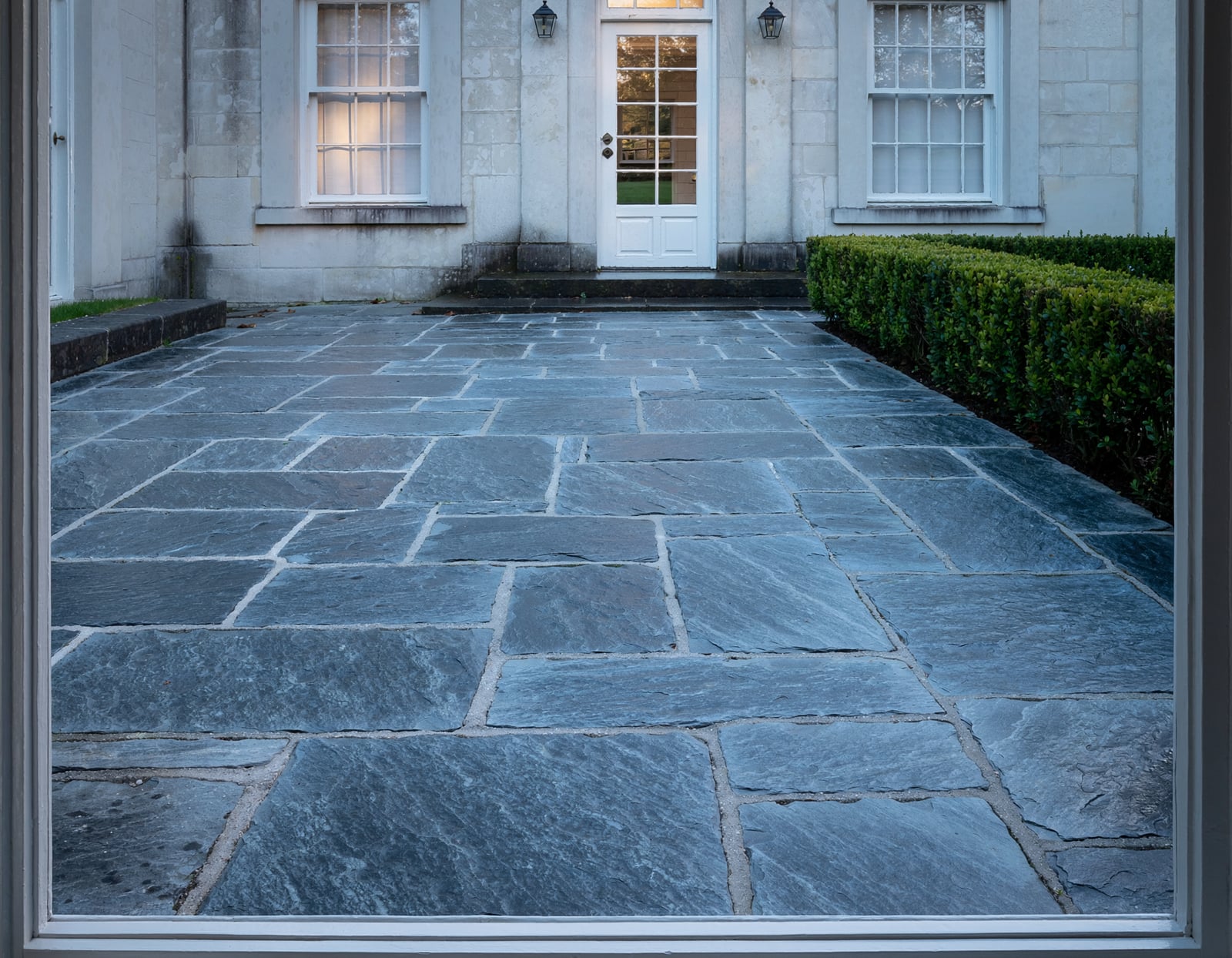
The view from inside a Georgian house looking out onto a Kilkenny Blue Limestone patio with large random-pattern flags and lime mortar joints, clipped box hedge to one side, soft evening light. Concept visualisation
From the doorway — random-pattern Kilkenny Blue flags, generous lime joints, box hedge edge.

The Heritage Patio costs €3,600–€6,800 installed for 30 m² in Ireland (2026). Built from sawn Kilkenny Blue Limestone laid in a true random pattern with lime mortar joints recessed three millimetres from the face of the stone, edged flush into lawn on a hidden concrete restraint. It suits Georgian, Victorian, and contemporary minimalist settings; it looks out of place against rustic or coastal architecture, where the Rustic Quartzite concept is the better match. Three decisions make or break it: the stone, the joint, and the edge.

The look

Sawn Kilkenny Blue Limestone — dense, fine-grained, with the distinctive blue-grey tone that deepens dramatically when wet. Flags of varied sizes laid in a true random pattern, with generous lime mortar joints recessed three millimetres from the face of the stone. No bullnose, no chamfer, no decorative borders. The patio meets the lawn flush on a hidden concrete edge restraint. Box or yew hedging frames it on the garden side.

The pattern matters. Random only works when the flags genuinely vary — typically four to six different sizes on a 30 square-metre patio. A “random pattern” cut from uniform 600 × 600 mm flags reads as inauthentic immediately. Specify mixed-size flags from the start.

Why Kilkenny Blue

This is the stone that has been used in Ireland’s finest interiors for centuries, and it works outdoors too with the right specification. The sawn finish is essential — riven Kilkenny is too rough for a formal patio and reads as paving rather than flooring. Sawn limestone develops a soft patina over a few years, the surface texture mellowing without losing its precision.

Limestone is softer than granite or quartzite (Mohs 3 vs 6–7) so it does require sealing outdoors to prevent acid-rain staining and to slow the natural patina if you want to preserve the dark-blue tone for longer. Lime-based mortar — not cement — is essential: it allows the stone and joint to move with frost without cracking, and it doesn’t leach white salts onto the face of the stone the way cement does.

What it costs

For a 30 square-metre Heritage Patio installed in Ireland (2026):

  • Stone supply: €2,250–€4,050 (Kilkenny Blue Limestone, sawn, varied sizes)
  • Sub-base and groundworks: €600–€900 (100 mm MOT Type 1 hardcore, excavation, edge restraint)
  • Laying and pointing: €800–€1,800 (bedding mortar, lime mortar pointing, falls)
  • Total installed: €3,600–€6,800

The wide range reflects access, complexity of falls, and the skill of the stonemason — a precise random-pattern lay with consistent joint widths takes considerably longer than a flag-and-go job and looks dramatically better five years on.

What to ask the stonemason

Three questions before you sign anything:

  1. Will the flags be of varied sizes — at least four different sizes on the lay? If they’re proposing uniform flags “cut to look random,” walk away.
  2. What mortar are you using for bedding and pointing? Lime-based, not cement. If they say “I always use cement, never had a problem” — walk away.
  3. What recess depth are you working to on the joints? Two to three millimetres below the face is correct for the Heritage look. Flush or proud joints are wrong for this concept.

Where to source

Kilkenny Blue Limestone is quarried in Kilkenny and supplied across Ireland and the UK. Stone Federation Great Britain and the Ethical Stone Register list verified producers and merchants. For sourcing and installation:
Alternate views

The same concept from different angles.

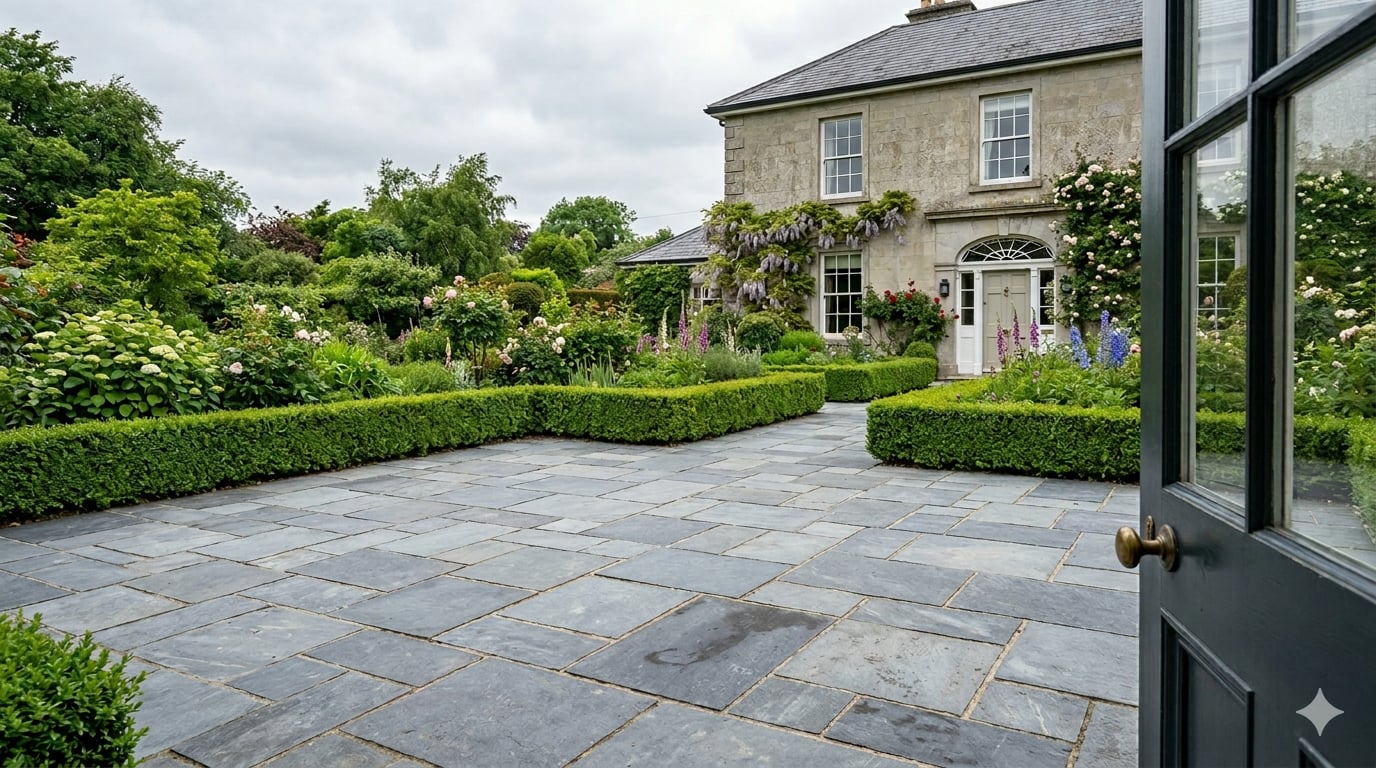
A wider view of the same patio from the garden side, showing the Georgian house with wisteria and roses, clipped box hedging framing the patio area in random-pattern Kilkenny Blue Limestone. Concept visualisation
Wider view — same patio set in a formal Irish garden, box-edged on the long side.

How it works

Plan and section drawings showing the layout decisions behind the concept.

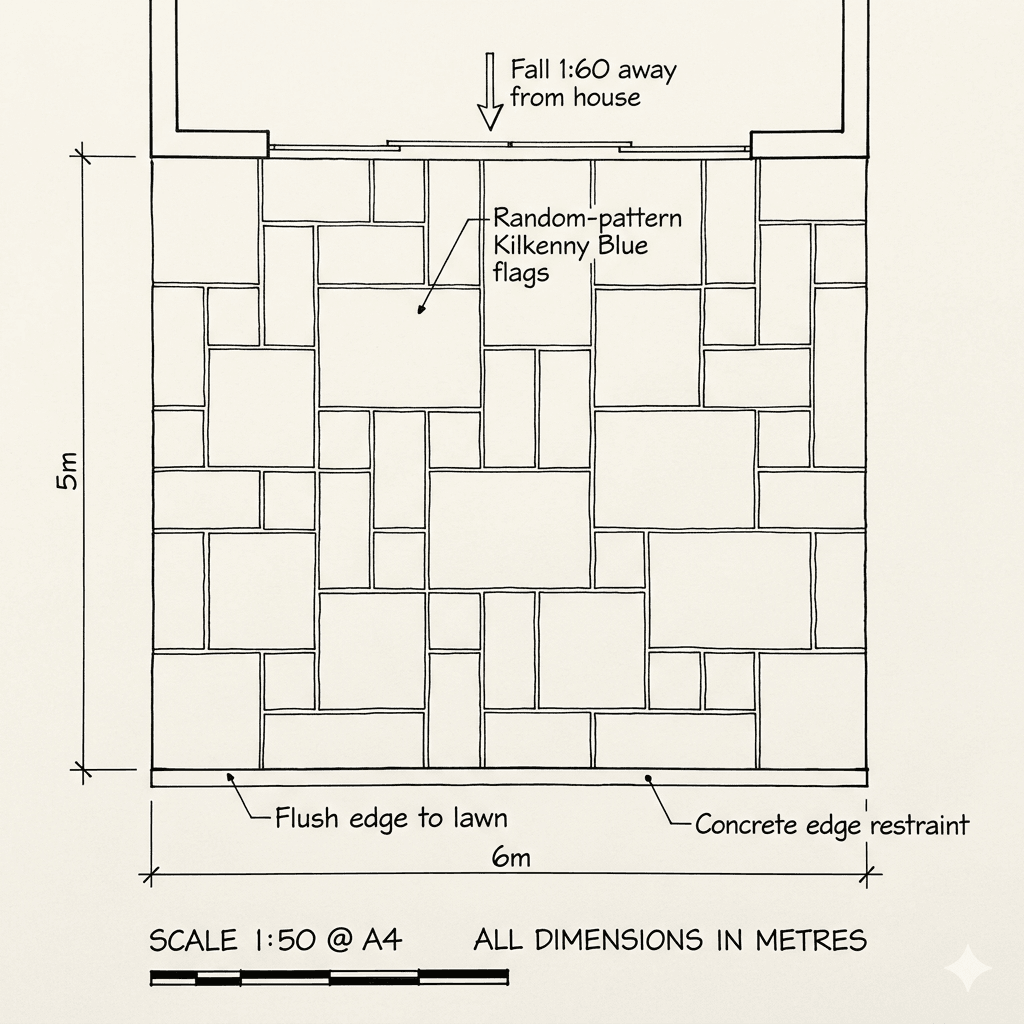
Top-down plan view of a 6 by 5 metre Kilkenny Blue Limestone patio with random-pattern flags of varied sizes, lime mortar joints, indicating a 1:60 fall away from the house and a flush edge transition to lawn. Concept visualisation
Plan view — 6 × 5 m, random pattern, fall of 1:60 away from the house, flush edge into lawn.
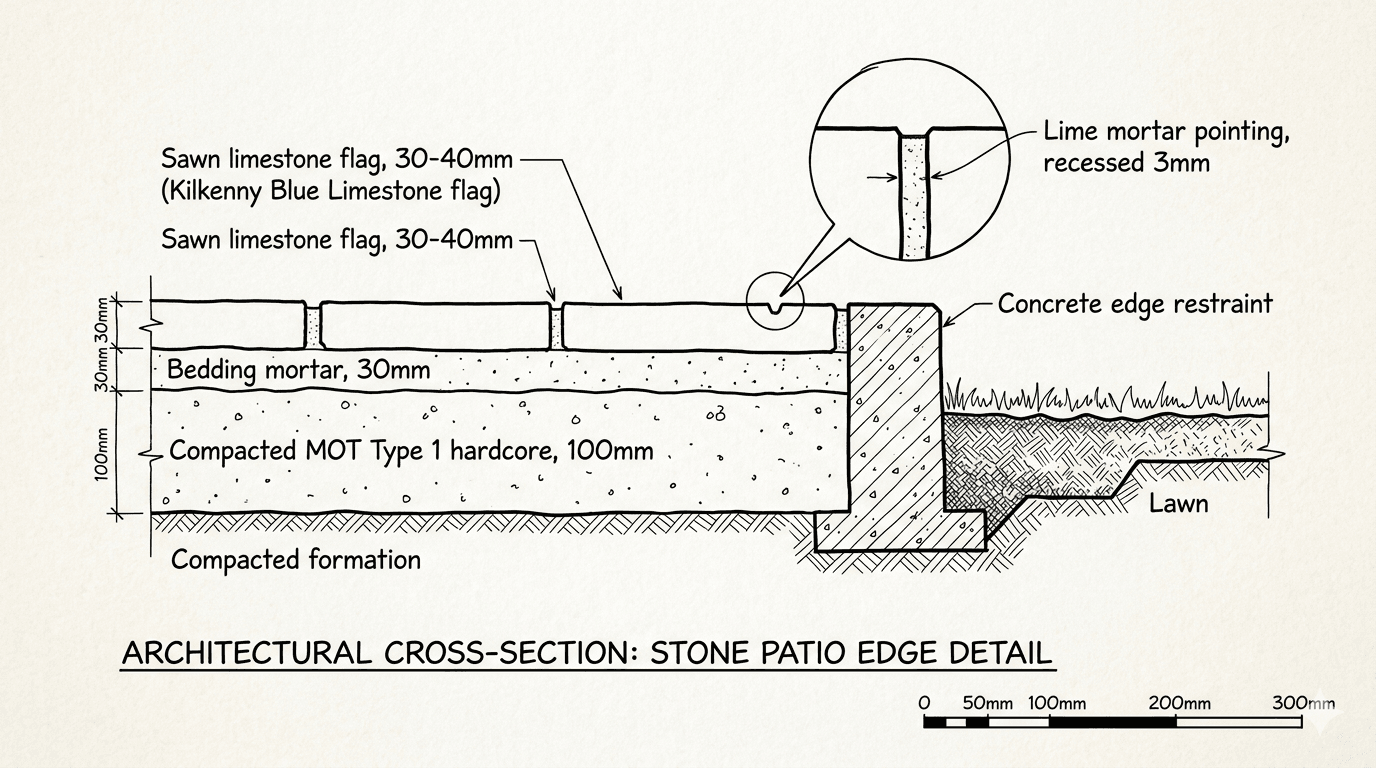
Cross-section drawing through the patio edge showing 100mm compacted MOT Type 1 hardcore sub-base, 30mm bedding mortar, sawn Kilkenny Blue Limestone flag, lime mortar pointing recessed from the face, and the transition to lawn on a concrete edge restraint. Concept visualisation
Section through the edge — 100 mm compacted hardcore, 30 mm bedding mortar, recessed lime pointing, concrete edge restraint.
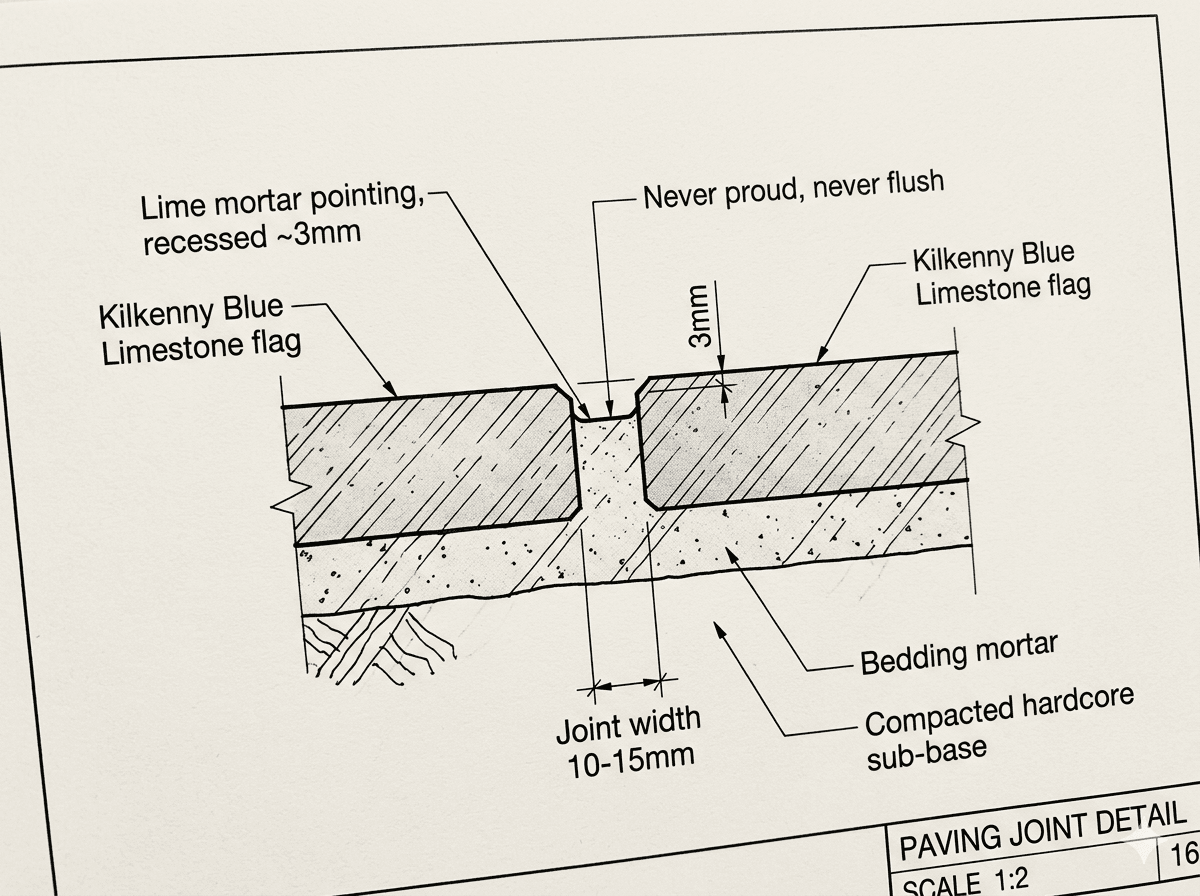
Close-up illustration of the joint between two Kilkenny Blue Limestone flags showing the lime mortar pointing recessed approximately 3mm below the face of the stone, with the cross-section indicating the bedding mortar below. Concept visualisation
Joint detail — lime mortar recessed ~3 mm from face, never proud.

The stone

Real material reference — open the Stone Library entry for full geology, suppliers, and finish options.

Ready to brief a stonemason?

Share this concept page as a starting point — the budget, stone, and detailing notes make for a clearer first conversation.

Frequently asked

Is Kilkenny Blue Limestone suitable for an outdoor patio?
Yes, when properly specified. Kilkenny Blue is more commonly seen indoors but sawn finishes are entirely suitable outdoors. It is softer than quartzite (Mohs 3–5 vs 6–7) and requires sealing outdoors to prevent acid-rain staining and to slow the natural patina. Best for sheltered or formal patios, period properties, and contemporary minimalist designs. Less suited to exposed coastal sites where Donegal Quartzite outperforms it.
What is the cost of a Heritage Kilkenny Blue patio in Ireland in 2026?
For a 30 m² Heritage Patio installed in Ireland (2026), expect €3,600–€6,800 total: €2,250–€4,050 stone supply, €600–€900 sub-base and groundworks, €800–€1,800 laying and lime-mortar pointing. The wide range reflects access, complexity of the falls, and the skill of the stonemason. A precise random-pattern lay with consistent joint widths costs more than a flag-and-go job and looks dramatically better at five years.
Why use lime mortar instead of cement on a Kilkenny Blue patio?
Two reasons. Lime mortar allows the stone and joint to move with frost without cracking — cement mortar is rigid and fractures under freeze-thaw cycles. And lime mortar does not leach white salts onto the face of the stone, which cement pointing routinely does on limestone within a few years. Lime-based mortar is the correct specification for natural stone in Ireland's climate; cement is wrong even when it works initially.
What makes a random-pattern patio look authentic rather than fake?
Flag-size variation. A true random pattern uses at least four different flag sizes mixed across the area — typically from 300mm fillers to 700mm or larger centrepieces. A 'random pattern' cut from uniform 600 × 600mm flags reads as inauthentic immediately because the rhythm of the lay is regular underneath. Specify mixed sizes from the quarry, and confirm with the stonemason before any stone is cut.
Does this concept work outside a period property?
Yes — the Heritage Patio works against contemporary architecture too, particularly minimalist or restrained modern designs that benefit from a single material reading as old. Sawn Kilkenny Blue with recessed lime joints is one of the most visually quiet patio surfaces available, which suits both Georgian formality and contemporary calm. It reads as out of place against rugged or coastal architecture where the Rustic Quartzite concept is the better match.

Other concepts in this project

About the visuals on this page. Images tagged Concept visualisation are AI-generated illustrations used to communicate design intent — joint patterns, layout, scale, edge details. They are not photographs of real installations. Where real stones are shown — in the material palette and any reference installations — those photos are real.